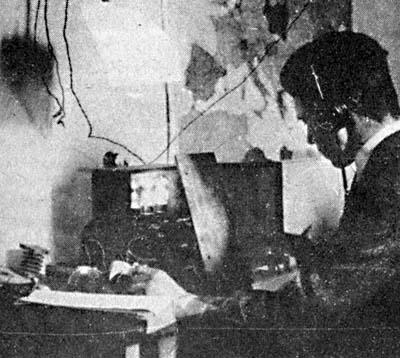
The extent of the development of radio began in the 1890's, however the full extent of an actual radio station was founded in the 1920's. Most of the radio programs around this time focused on being entertainment-based, which included music, or drama. Other programming involved limited coverage of high-profile political events, sports and instructional programs on a variety of ordinary topics such as cooking. Nearing the 1930's the radio introduced a Ten minute "NewsCasts", these were created by Time magazine working in conjunction with radio executive Fred Smith are broadcast by various stations nationwide.
On the dawning of the 1930's brought the introductions of programs like "The University of Chicago Roundtable" broadcast by the NBC. The included individuals from universities that would engage in intellectual discussion. This slightly resembles later phenomenon of talk radio.
During the 1950's, when radio was dominant and the airwaves were filled with a variety of radio formats and genres, people tuned in to their favorite radio programs on a regular basis. According to a 1947 C. E. Hooper survey, 82 out of 100 Americans were found to be radio listeners. The 1950's brought a whole new revolution of the radio, pirate radio stations. This brought the rock 'n' roll generation. However along with this new introduction, we also had the pleasure of meeting the television set. Suprising as it may seem this did not really effect the radio's listener views, as not many people owned televisions, and those who did would not have seen much of it anyway as programmes were barely shown. Although the pirate radio's were very popular with many, pirating laws were introduced to those broadcasting without a lisence. With the introduction of this law many stations were shut down slowly, so this caused other legal radio stations to broadcast the roll 'n' roll type music to keep us all quite satisfied.
The 1960's brought a new level of radio, as in 1967 the now well known and still as popular, Radio 1 was proudly introduced to all listeners. Along with this the new invention, Digital Audio Broadcast was also new on the block, this is quite vast to the old wave radio, as these stations could be listened to electronically. This meant no more struggling to find stations that were clear to listen to. Following this there are now many Public Service Broadcasting radio stations which are all of the BBC radio stations, BBC Radio 1,2,3,4,5 etc. Along with commercial radio stations now know as Heart, kis, capital fm ect.
Even now as many years have passed radio is still quite a popular form of listening to music. If someone has a tape player in their car, i am pretty certain that they would rather sit and listen to a clear radio, rather than listen to a fuzzy old tape that you can hardly differenciate the song's lyrics. I believe that radio will still be with us for as long as we are all here on earth, after all it is much too great an invention to just forget about and leave behind.
During the 1950's, when radio was dominant and the airwaves were filled with a variety of radio formats and genres, people tuned in to their favorite radio programs on a regular basis. According to a 1947 C. E. Hooper survey, 82 out of 100 Americans were found to be radio listeners. The 1950's brought a whole new revolution of the radio, pirate radio stations. This brought the rock 'n' roll generation. However along with this new introduction, we also had the pleasure of meeting the television set. Suprising as it may seem this did not really effect the radio's listener views, as not many people owned televisions, and those who did would not have seen much of it anyway as programmes were barely shown. Although the pirate radio's were very popular with many, pirating laws were introduced to those broadcasting without a lisence. With the introduction of this law many stations were shut down slowly, so this caused other legal radio stations to broadcast the roll 'n' roll type music to keep us all quite satisfied.
The 1960's brought a new level of radio, as in 1967 the now well known and still as popular, Radio 1 was proudly introduced to all listeners. Along with this the new invention, Digital Audio Broadcast was also new on the block, this is quite vast to the old wave radio, as these stations could be listened to electronically. This meant no more struggling to find stations that were clear to listen to. Following this there are now many Public Service Broadcasting radio stations which are all of the BBC radio stations, BBC Radio 1,2,3,4,5 etc. Along with commercial radio stations now know as Heart, kis, capital fm ect.
Even now as many years have passed radio is still quite a popular form of listening to music. If someone has a tape player in their car, i am pretty certain that they would rather sit and listen to a clear radio, rather than listen to a fuzzy old tape that you can hardly differenciate the song's lyrics. I believe that radio will still be with us for as long as we are all here on earth, after all it is much too great an invention to just forget about and leave behind.
Bibliography
http://faculty.uml.edu/sgallagher/radiotimeline.htm
http://www.crk.cz/PICTURES/JPG/OK1AB_1923.JPG
http://www.buzzle.com/articles/history-of-radio-who-invented-the-radio.html


No comments:
Post a Comment